Film review – 思い出のマーニー / When Marnie Was There (Hiromasa Yonebayashi, 2016)

The latest film released from the Japanese animation powerhouse Studio Ghibli is also the final feature film they will ever release. At least, that’s the line they’re taking. There doesn’t seem to be any indication that this isn’t true, although secretly most Ghibli fans – myself included – hope there will be something else around the corner. 

A glimmer of hope has come in the suggestion that more short films will be produced for the Saturn Theatre, the small cinema that resides inside the Ghibli Museum in Tokyo. Unfortunately for those of us outside Japan, seeing the existing ones is quite the task – you’ll need at least a return plane ticket to Japan and some forward planning to get tickets to the museum itself. Oh, they only screen one film a day and you can only see it once. There isn’t any plan to screen any of them anywhere else in the world, so seeing the sequel to Totoro might not be something to add to your bucket list.

All this sadly leaves us with only one more Studio Ghibli film to enjoy at the cinema, finally seeing the light of day almost two years after its release in Japan. When Marnie Was There is based on the original novel of the same name by British author Joan G. Robinson, with many of the details changed from the original novel. Most notably, the location has been changed from Norfolk in England to Sapporo in Hokkaido, Japan.


The storyline deals with a young girl, Anna, who suffers from anxiety and asthma. A loner at her school and lacking in confidence, she is sent away to live with family friends in Sapporo on the advice of her doctor, who suggests that leaving the city for the clearer air and change of scenery will cure her ailments.

Once there, she struggles to settle until she happens on a mysterious building called The Marsh House, inside which a beautiful young girl name Marnie is living, a girl with whom she strikes up an immediate and very close friendship.

So how does When Marnie Was There fit into the greater Ghibli catalogue? Instantly it will strike you that it’s just as beautifully animated as anything we’ve seen before, with hand-drawn drawings taking us on the typically personal, solitary journey of the main character. Animation has seldom looked this good, and I include Disney’s output in this statement too.

The storyline will be familiar to those fans of previous Ghibli works. A young girl sent away from her comfort zone to new surroundings dealing with a secretive and mysterious occurrence, via an unlikely friendship. It is ground well worn, but that shouldn’t be a reason to dismiss it. 

Anna herself is a wonderfully realised creation. The sense of isolation as she sits at school having an asthma-induced panic attack is heartbreaking and as realistic as any live-action portrayal of anxiety I’ve ever seen. This is a critical achievement – get it wrong and we’re dealing with a whiny self-obsessed teenager for two hours.

It is perhaps not as immediate as some of the more celebrated works. It’s a frustrating time to be a Ghibli fan. It’s probably the last film to hit the big screen, but it’s not the best place to start if you’re unfamiliar with the studio. If you can, watch My Neighbour Totoro and Spirited Away straight away, then head to the cinema to catch this before you run out of time.

Haiku film review #020 – Seven Samurai

So I’ve just got back from an amazing trip to Japan. We were lucky enough to be there during cherry blossom season. So, on a slightly overcast afternoon at Ueno Park in Tokyo I enjoyed the festivities and spent some time under the sakura writing haiku poems about Japanese films.

The second one I wrote was for Seven Samurai:

     These samurai rule.
     Let’s steal and change the story
     For our cowboy film.

Eleven Japanese phrases that are hilariously similar to their English counterparts

In learning Japanese, I’ve come across a few phrases that are so similar to their English counterparts they sound like someone doing an offensive impression of someone from Japan without any knowledge of the language.

Whilst they sound quite humorous at first, they are so easy to learn for native English-speakers that they should be seen as a quick win for anyone trying to learn the language.

Here we go!

1. Gēmusentā – Game centre

Yep! That’s the phrase to describe a video game arcade. If you’re anything like me this is a key phrase for when you go to Japan as there are so many to experience in Tokyo.

2. Kurejittokādo – Credit card

A really useful phrase for shops and cafés. Even if you can’t construct “Do you take credit cards?” as a full sentence (“Kurejittokādo wa tsukae masu ka?”), holding your card and saying the English phrase with an “o” sound at the end is a start.

3. Merii Kurisumasu – Merry Christmas

Might only be useful for you for about three days in a year, but say it confidently despite the fact it sounds like you don’t know what you’re really saying.

4. Kukkī – Cookie

I mean, it’s not even different.

5. Sandoitchi – Sandwich

That’s not far off either. Just put a quick “oh” in the middle and an “ee” sound at the end and you’ve got a great accompanying snack for your kukkī.

6. Remonēdo – Lemonade

One thing that people in the west do when trying to impersonate Japanese speech in a derogatory manner is to swap all the “l” letters for “r” sounds and vice versa. This is because neither letter exists in Japanese. However, if you’re partial for lemonade then you’re in luck because that’s exactly how you say it. Just try not to look embarrassed when you ask for “Remonēdo kudasai”.

7. Kyasshu disupensa – Cash dispenser

Or you could have “e-ti-emu”. I’m not joking. In many ways, having two phrases in your arsenal for one thing is borderline fluent.

8. Hoteru – Hotel

An easy and very useful one to remember!

9. Aisu kurīmu – Ice cream

I love this one and can’t wait to use it next time I fancy some ice cream.

10. Amerikandoggu – American dog (or hot dog)

Not quite perfect translation on this one as people in the west don’t tend to order an “American dog”. Then again, I imagine “Japanese noodles” are just “noodles” in central Tokyo.

11. Koin rokkā – Coin locker

A little like number six, this does sound a bit like a westerner poking fun at the way Japanese people speak. Similarly “koin randorī” will be a useful phrase if you’re backpacking and you need to wash your clothes.

There you have it. In “tsumari” (another real one), if you find yourself in Japan around the 25th December and find yourself hungry in a Tokyo video game arcade but without any cash, then I have just sorted you out big time. You’re welcome.

Film review – みな殺しの拳銃 / Massacre Gun (Yasharu Hasebe, 1967)

A stylish yakuza film originally released in 1967, みな殺しの拳銃 / Massacre Gun has received a lovingly-created remastering by Arrow Video that’s well worth picking up for fans of the genre.

The plot concerns three brothers. Ryûichi (Joe Shishido) is the eldest; he’s level-headed but he’s also a member of the Akazawa yakuza gang, turning on his employees when he is forced to murder his lover. Eiji (Tatsuya Fuji) is the middle brother – hot-headed but loyal to his siblings. The youngest, Saburo (Jiro Okazaki), is an aspiring boxer who over-exerts himself at a training session to prove his worth, infuriating the yakuza bosses who now have an injured star fighter. When the yakuza seek retaliation on him and ruin his career, this is the catalyst for their feud to quickly get out of control. Tensions rise as the stand-off escalates to full-blown gang warfare and a brutal final shootout.

The film oozes style. The sultry jazz soundtrack provided by Naozumi Yamamoto is almost a character in itself, providing an edge to the sharply-dressed brothers and the gritty world they inhabit. The monochromatic tones serve the film in a way that full-colour just wouldn’t have achieved.

massacre gun still

There’s a unique edge to everything that happens in the film, which is clearly an attempt by Yasharu Hasebe to mirror typical American film noirs. The world these characters isn’t a world that a typical viewer is familiar with outside of cinema, though the dedication to the genre is so absolute that it becomes absorbing. True, there are better film noirs out there, though few give themselves so absolutely to the concept of film noir itself.

However, there is something extraordinarily off-putting about the appearance of lead actor Joe Shishido. His cheeks seem puffed-up and almost chipmunk-like. Apparently, and I only found this out after seeing the film, this was by choice. He had his cheekbones enhanced to give himself a more masculine appearance. This really isn’t the case. In this particular film he looks like the most unlikely of lead actors, especially alongside his two brothers. It is an unnatural appearance, though it has the unintentional affect of providing Shishido with a heightened sense of being the underdog, which plays into the plot wonderfully.

This is a mere minor annoyance in an otherwise perfectly good film. It lacks the notoriety of the more popular Shishido yakuza film noir released in the same year – Branded To Kill – but both seems to inhabit the same world and will reward fans of the genre willing to seek it out.

Massacre Gun is out now on Arrow Video dual format Blu-ray and DVD, limited to 3000 copies.

Film review – 千と千尋の神隠し / Spirited Away (Hayao Miyazaki, 2001)

Whilst Studio Ghibli has been a powerhouse of cinema in the East for many decades – since being born of the release of 風の谷のナウシカ / Nausicaä of the Valley of the Sea in 1984 – many Western cinema-goers weren’t introduced to the wonders of the animation house until 2003. This was the year that Spirited Away reached the wider audiences after being nominated and winning the Academy Award for Best Animated Feature.

Those whose interest was peaked enough were rewarded with a fantastic picture realised in beautiful 2D traditional animation. Its use magically imaginative turns that seemed uniquely Eastern mesmerised the audiences, allowing its popularity to grow through word of mouth and causing a renewed interest in the studio’s back catalogue. 

The story itself follows ten-year-old girl Chihiro who is moving house to a new and unfamiliar location with her parents (a familiar opening gambit in a Ghibli picture). Accidentally stumbling upon an abandoned amusement park, her mother and father greedily consume some mysterious but luxurious food whilst Chihiro investigates the surroundings. By the time she returns, her parents have turned into pigs and she cannot escape, forcing her to go deeper into the mysterious world to try to work out how to turn her parents back to humans and allow her life to return to normality.

SpiritedAwayscreenshot

In its most basic form, it is a coming of age tale akin to Alice in Wonderland, with a setting that is just as supernatural as the western equivalent. She is forced to find her identity as an adult after having her childhood identity removed from her – including her name – and only by doing so can she bring back her parents.

Whether this means the film is set in a supernatural world, or the middle portion of the film is simply a figment of her imagination is open to debate. Certainly the possibility is there that she has slipped into a dream and this is a manifestation of her fears and resistance to growing up. However, Miyazaki clearly decided to show that Zeniba’s hair band was still in her hair after her return to the “normal” world, a move to clearly show this wasn’t a dream at all. A subtle but sweet reveal.

It was a reminder of how to do it properly. Disney was yet to move away from traditional animation in favour of the 3D animation being celebrated by the likes of Pixar and Dreamworks, instead releasing both Lilo and Stitch and Treasure Planet in the year this reached western cinemas.

In contrast, Studio Ghibli wasn’t afraid to aim squarely at a more adult audience, and hadn’t been for years. Spirited Away was just the tip of the iceberg – representative of a rich body of work but standing out as one of their greatest achievements.


浪華悲歌 / Osaka Elegy (Kenji Mizoguchi, 1936)

浪華悲歌 / Osaka Elegy, now eighty years old, came midway into director Kenji Mizoguchi’s career. Despite this, it is one of the earliest examples of Kenji Mizoguchi’s work readily available to view by the general public and has just been restored and released by Artificial Eye as part of a boxset titles The Mizoguchi Collection.

By today’s standards, it has a strange narrative that seemingly unravels itself from a reasonably happy place to a completely unhappy place for everyone unlucky enough to be wound up in the story. It is built around telephone operator Ayako (Isuzu Yamada), a girl who uses manipulation out of desperation for her own family. Her father is struggling to keep afloat financially after finding himself unemployed and owing 300 JPY. Her brother is also in desperate need of money to pay for his tuition fees or he will be thrown off his course. A solution presents itself in the form of Sumiko Asai (Yoko Umemura), the owner of a successful drugs company who has taken a shine to Ayako. Agreeing to be his mistress to solve the financial issues, she soon realises that the solution isn’t quite as simple as she had hoped.

The topics covered by the film are explored and exploited. It’s a clever technique as the initial story seems quite bland. As the reality is revealed to those involved Ayako comes out as the only person to be perceived to be in the wrong. Several men have had an affair with a girl under half their age, effectively buying her time, but they are above the law due to their standing in society. Since she is perceived to be of a lower class, it is on her that the blame is left.

She was in fact trying to live by her giri morals – the duty to do right by ones family. Whilst her methods may be unorthadox, she never sways far from these morals. The most upsetting part is her final line in the film, revealing that she believes herself to be a delinquent.

The quality of the film is lost slightly by the poor condition of the remaining footage. Throughout the film there are issues with sound – the constant background hiss is quite off-putting, there’s the odd loud pop and the dialogue can feel muffled. It’s not inaudible, but a far cry from perfect.

Similarly, the picture quality is poor, particularly in the darkened interiors of the traditional Osakan houses where the blacks appear muddy. This, like the sound, is not the fault of Artificial Eye. They’ve clearly made a decent job of some imperfect source material. It’s a shame, but realistically this is a business venture and spending the money to restore relatively obscure Mizoguchi films would be hard to justify.

As I understand, the other three films in this box set (The Story of the Last Chrysthanthemum, Utamaro and His Five Women, Sisters of the Gion) are all in the same boat, with imperfections in both audio and visuals (I haven’t watched them yet). That these films have surfaced at all is enough to be grateful for and those looking for more Mizoguchi after enjoying the Master of Cinema releases will be well served. As such, despite the flaws this box set is a recommended purchase.


青春残酷物語 / Cruel Story of Youth (Nagisa Oshima, 1960)

Released in 1960, Nagisa Oshima’s cutting critique of Japanese outsider youth culture was an unexpected success upon its original release, amid controversy and criticism over its content. Viewed now in its glorious 4K scan restoration by Shochiku, it is an enjoyable, if flawed, experience.

It is the story of high-school girl Makoto (Miyuki Kuwano), who we first see being advanced on by a sleazy middle-aged man. She is saved from being sexually assaulted by Kiyoshi (Yusuke Kawazu), a university student. As their unconventional romance blossoms, so too does their alienation from the society around them, running a corrupt business that involves using Makoto to lead men on, only for Kiyoshi to appear and demand payment to keep them from going to the police.

An unusually morose ending to the film.

An unusually morose ending to the film.

Clearly this isn’t an ideal way to build a relationship and it is by no means a traditional love story. It does make for an interesting dynamic for our two leads. At least, it would do but for an underwhelming performance by Kawano. Whilst Kawazu perfectly plays the disillusioned and rebellious student on the cusp of either prison, gang warfare or death, his female counterpart struggles with the dynamics that the role demands.

In a memorable early scene, soon after Kiyoshi saves Makoto, he takes her to the local docklands, forces himself on her, then threatens to drown her. It’s an uncomfortable scene to watch due to the nature of the content, but her efforts to make it look like she’s struggling to swim let the scene down. It’s also not very convincing that she is either desperate to avoid his advances, nor is the contrast to her giving in particularly stark.

This is all filmed in a brilliantly bold colour wash by Ôshima, which creates an unusual but impressive contrast to the wholly depressing content of the film. The negativity contained in the social commentary surrounding outsider youths became a staple of Ôshima’s later films. Whilst it isn’t a masterpiece, it is not without merit.

The package offered by Eureka and Masters of Cinema makes this release another great value for money Blu-ray. The transfer is top class and the booklet and extensive discussion with scholar Tony Rayns give a massive insight into the film. It’s rather like a short film study course on the film. If you can find an equivalent for around £10 then you’re doing well.

青春残酷物語 / Cruel Story of Youth is available on Blu-ray now.

Shohei Imamura Masterpiece Collection – Preview

This week Masters of Cinema announced the release of a new boxset titled Shohei Imamura Masterpiece Collection. So what does it contain and is it worth a purchase?

The box contains eight films, all of which have already been released before. The contents are as follows:

盗まれた欲情 / Stolen Desire (1958)
西銀座駅前 / Nishi Ginza Station (1958)
豚と軍艦 / Pigs and Battleships (1961)
にっぽん昆虫記 / The Insect Woman (1963)
人間蒸発 / A Man Vanishes (1967) – DVD only
神々の深き欲望 / Profound Desires of the Gods (1968)
復讐するは我にあり / Vengeance is Mine (1979)
楢山節考 / The Ballad of Narayama (1983)

In the Blu-ray era of Masters of Cinema, only three other boxsets have been released. The first was the three-film Martin Scorsese Presents World Cinema Foundation Volume One boxset, the second was the excellent Late Mizoguchi boxset and the final was the Shoah five-film boxset. All are worthwhile boxes to buy full of new films that hadn’t seen the light of day prior to their release (apart from the Mizoguchi release, which only had four  newly-transferred-to-HD films out of eight).

For those with any or all of the contents of this newly announced box, it no doubt represent a disappointing announcement. I was aware there was a gap in the numbering of the Masters of Cinema Blu-Ray releases, between 120 Medium cool and 129 Dragon Inn, so I was hoping that an eight-film director-centric boxset would be announced. Having just got back into Imamura I was underwhelmed when I realised the boxset would contain eight films, seven of which I already own on Blu-Ray.

That said, the films include one Palme d’Or winner, two Blue Ribbon Best Film winners, Imamura’s debut film and some excellent insights into the career of a film director considered to be one of the greatest ever to come out of Japan. Not every film is amongst his best – notably Nishi Ginza Station is fairly poor – but if you have a copy of both The Eel and Black Rain (not Masters of Cinema) then you’ll have pretty much all of his most important works. It spans his entire career and represents the only way in the UK to get any of his films on Blu-Ray.

Importantly, it is rumoured that this will be the last chance to buy these films as part of the Masters of Cinema releases as they have let the rights lapse on them. If this is true, and you don’t have these films yet, then this is a must-buy.

The Shohei Imamura Masterpiece Collection boxset is available for pre-order now.

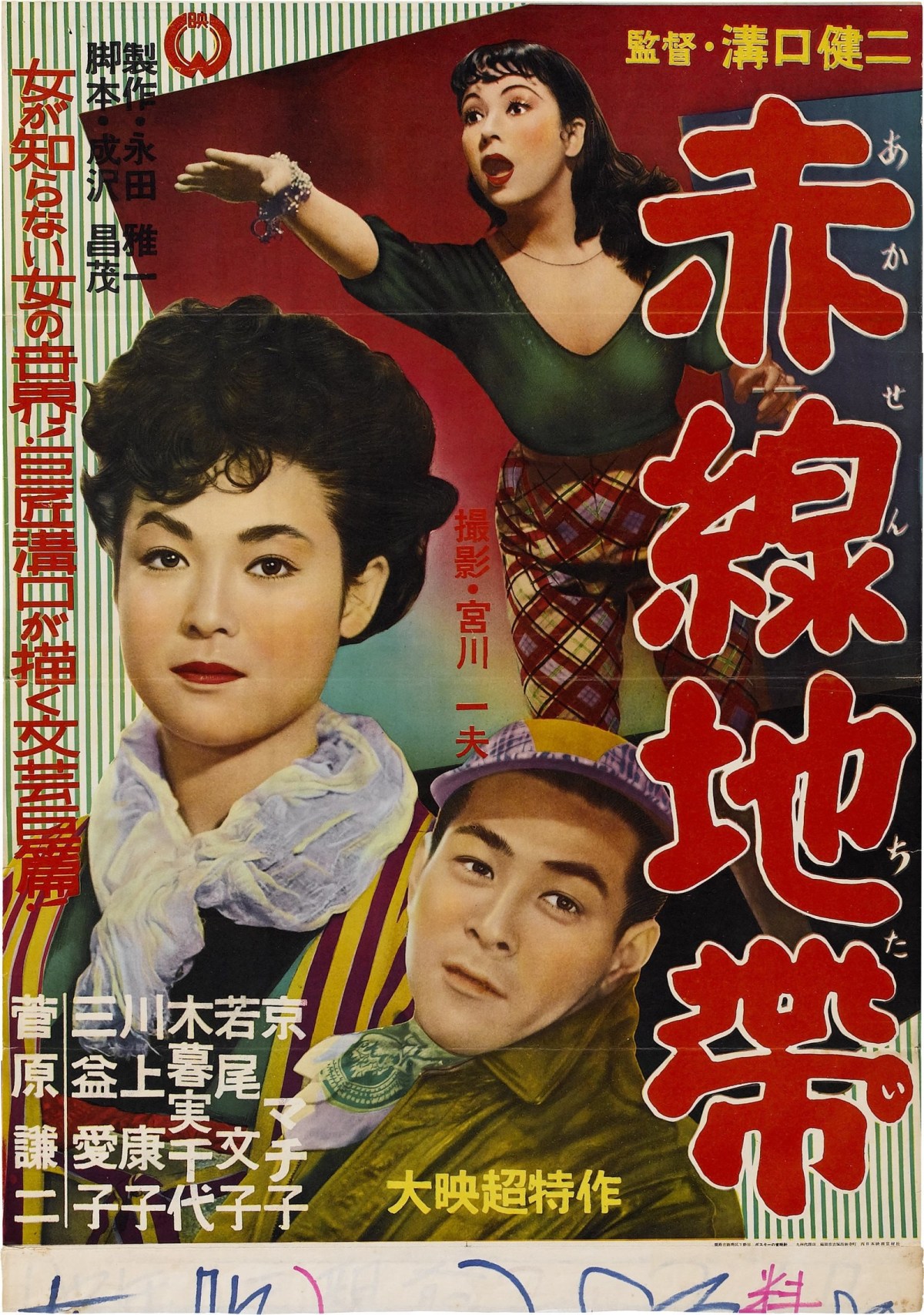
赤線地帯 / Akasen Chitai (Kenji Mizoguchi, 1956)

One of the highlights of the Late Mizoguchi boxset, and indeed Mizoguchi’s entire career, is the film Akasen Chitai. Literally translated as “red-line district”, the film concentrates on the legal brothels of post-war Tokyo. Two months after its release a groundbreaking law was passed in Japan that made prostitution illegal in Japan, putting an end to the “red-line” and “blue-line” zones that had operated up to that point. Mizoguchi would die in August of the same year whilst developing his next film “An Osaka Story” (later directed by Kōzaburō Yoshimura). This Akasen Chitai would prove to be his final film.

The five stars of a five-star film.

The five stars of a five-star film.

The film follows the fortunes of five prostitutes working in Dreamland, a legal brothel, contemplating their future should the Diet pass a law to make their profession illegal. The five lead characters – Yasumi (Akayo Wakao), Hanae (Michiyo Kogure), Yumeko (Aiko Mimasu), Yorie (Hiroko Machida) and Mickey (Machiko Kyô) – all form a central part of the plot in different portions of the film.

Hanae has arguably the most heart-breaking story. Trying to make ends meet to support a young child, her husband suffers from depression and suicidal tendencies as his inferiority engulfs his being. She is not a natural in her profession as her colleagues and if often criticised for her “scruffy” appearance. The only thing she fears more than her job is the possibility that she will lose her job in the near future. It is a complex and depressing sub-plot that

Conversely, the glamorous Yasumi is a compulsive liar who is playing on the emotions of her most devoted client to get him to buy her presents and give her monetary hand outs. It takes a skilled director to convince the audience to find sympathy for such a character, but that he does.

It is Mickey that eventually becomes the focal point of the plot. She arrives as a young and confident new employee at Dreamland and immediately proves popular amongst the clientele. Whilst her colleagues are all working out of desperation and a hope for a better life, it later transpires that Mickey has runaway from the home of her successful business-owning father. The scene in which he arrives to take Mickey home and avoid a family scandal is perhaps the film’s most powerful and memorable, full of elements of the mise en scène Mizoguchi was so famous for.

Whilst the overarching message is that of depression and desolation, the the film is effective because the characters are believable. There are also elements of humour littered throughout. For example, when the aging Yorie discovers one of her frequent clients with the younger Mickey. An argument ensues and the client calls her a whore, to which her response is “If I’m a whore then what does that make you?”, setting up the perfect response: “I’m the client!”

It may not have been his planned swansong, but Akasen Chitai is an excellent way to bookend the career of a masterful director.

Akasen Chitai is available as part of the late Mizoguchi boxset, though you may find the price of the DVD a little more palatable.