Bridge of Spies (Steven Spielberg, 2015)

After a relatively long break, Steven Spielberg is back behind the director’s chair, and it was worth the wait.

Reading the description of Bridge of Spies, his first film since the hugely successful biopic Lincoln, it has all the hallmarks of some of his greatest achievements in cinema. It’s based on a true story. It’s a story about individual battles within a larger situation. It stars Tom Hanks. It would have been a surprise if this wasn’t a huge success.

Set between 1957 and 1960 during the height of the Cold War, the film focuses on James B. Donovan (Hanks), a lawyer tasked with negotiating the release of Francis Gary Powers (Austin Stowell), a pilot whose U-2 spy plane has been shot down over the Soviet Union. The negotiation concerns trading Powers for Rudolf Abel (Mark Rylance), a Soviet KGB spy held captive in the USA who Donovan has previously defended in court. However, tensions rise when Donovan shows his determination to include an additional US citizen – student Frederic Pryor (Will Rogers) – in a move that seemingly only he is keen to see through.

bridgeofspiesscreenshot

The film at times threatens to be sabotaged by a slow pace, though Spielberg keeps it going just enough to avoid it becoming a snooze-fest. The plot is one full of intricacies that reward the attentive viewer, so I’m not sure the modern audiences will get it in the same way they did with Schindler’s List, for example. [1]

This is an ode to traditional storytelling and any movements it makes to remind us of Spielberg’s supreme talents are trumped by its underlining of Tom Hanks as one of the greatest living actors. This is not a story about espionage, politics or the Cold War. It is a film about one man’s unwavering desire to stick to his principles. Hanks portrays Donovan as a totally unassuming man whose aggression is only touched on when he feels the principles for which he stands are threatened. As with most of his best roles, it has a way of pulling you in and asking you what you would do in his shoes.

If it is considered for any awards in the next few months, it will be for Hanks as an actor in a leading role. For all the clever cinematography and attentive set design, they are merely the stage on which Hanks is allowed to fly.

Bridge of Spies is release in cinemas worldwide on 27th November 2015.

[1] I’m well aware that this sounds condescending. It is fueled directly by the woman in front of me who three times during the film decided to have a quick check of her phone next to her pocket. Whilst it was only a minor distraction for me (it wasn’t so bad to warrant me tapping her on the shoulder), she missed two critical plot points and the description of what the characters did next in the final credits. Definitely a justification for the theory that the audience’s participation level is as important as the care put into a film.

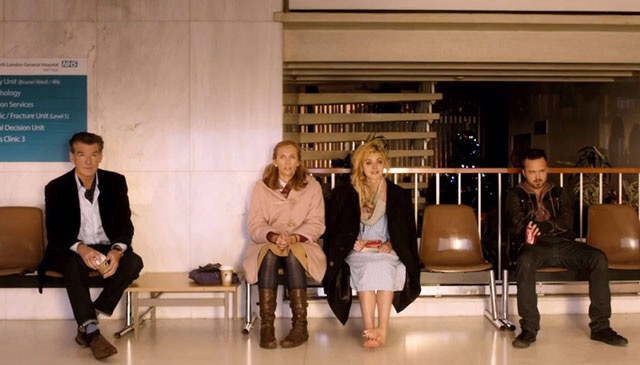
The Long Way Down (Pascal Chaumeil, 2014)

The latest Nick Hornby book to be given the big-screen treatment, The Long Way Down is on the face of it quite a distasteful basis of a comedy drama. The premise is that four people – played by Aaron Paul, Imogen Poots, Toni Collette and Pierce Brosnan – go to the top of a tower on New Year’s Eve with the same intention: the commit suicide. Talking each other out of it, their shared experience brings them closer together and they form an unconventional but essential bond.

It isn’t one of Hornby’s best films. Perhaps it’s the disbelief I found in the unlikely friendship they build with one-another. Perhaps it’s the light-hearted touch with which director Chaumeil has dealt with the source material. Perhaps it’s the fact that all the main characters are annoying in their own special way. Perhaps it’s just that I don’t want to see a comedy about suicide.


That’s not to say that all potentially distasteful comedies have nothing to offer. 50/50 was probably the best comedy I saw in 2011. I guess it just has to be dealt with in the right way.

There are some effective moments. The scene in which Rosamund Pike cameos is a precursor of her sinister turn in Gone Girl. Poots gives an assured performance throughout, giving life to a potentially film-ruining character. There is a heart-wrenching moment near the end with Collette and her son, which adds a lot of depth to her character, albeit late in the day.

I liked the way the film resolved itself. I just didn’t really enjoy the journey that took me there.

The Long Way Down is available on Blu-Ray, DVD and Netflix now.

世界 / The World (Jia Zhangke, 2004)

Time for another Masters of Cinema review, this time for Jia Zhangke’s 2004 Chinese film 世界 / The World. Originally screened in competition at the Venice Film Festival, it soon found its way onto the Eureka label on DVD and subsequently again on a Blu-ray/DVD dual-format release.


The story covers a short period of time of two workers at Beijing World Park: Tao (Zhao Tao) and Taisheng (Chen Taisheng) Tao’s boyfriend and a security guard at the park, whose relationship becomes increasingly strained throughout the period of the gloomy film. The theme park (a real park in Beijing) recreates famous cities and landmarks from around the world but in reduced scales, mainly for tourists. The story delves into the emotional and financial instability of the two lead characters and their colleagues, and how these two factors go closely hand-in-hand in modern China.


At 135 minutes long and with an extremely slow pace, The World is a tough film to sit through and maintain focus. The dialogue isn’t very focused, with the effect of making the characters feel wholly depressed. Unfortunately, whilst it’s fine to do this, when you’ve not really getting very far along the characters’ journeys your mind does start wonder. I had to take a couple of breaks to get through it, and that’s doesn’t really indicate a story that has me gripped.


There were some clever techniques utilised. Lead character Tao continually lost herself in her inner thoughts, removing herself from her own depression into a world represented by brightly coloured animation. This is something I saw more recently in Giovanni’s Island, probably to much better effect, but it doesn’t detract from the solid concept.


By the end of the film, I didn’t really feel emotionally involved in any of the characters and was quite relieved when it was all over. It’s not a film I will be revisiting any time soon.


世界 / The Worldis available on Masters of Cinema Blu-ray and DVD dual-format release now.

A Most Violent Year (J. C. Chandor, 2014)

J. C. Chandor’s crime drama A Most Violent Year is a well produced piece of cinema that tells an interesting story in a solid manner. However, after sitting through over two hours of its mid-paced plot development, it failed to wow me.

The film stars Oscar Isaac as Abel Morales, the hard-working owner of Standard Oil, and Jessica Chastain as Abel’s wife Anna, with supporting roles from Alessandro Nivola, David Oyelowo, Albert Brooks, Elyes Gabel and Catalina Sandino Moreno. It covers a short but crucial period in Abel’s career as he battles against police and corruption to pull of a deal that will see his small company become a big player in 1981 New York’s oil and gas buying and selling industry.

Isaac looks uncannily like a young Al Pacino in his lead performance, and that may accidentally be to the film’s detriment. Essentially, what we aren’t going to get from this quite understated film is a shot of Isaac gunning down thugs and gangsters from a pile of bank notes and drugs, although the tone of the film could easily have ramped up to this had they wanted to go there. It’s a serious story that didn’t need to fall into some over-the-top cliches, and the film is better for it.

That said, when you’re watching such a long film you’d want slightly more to the plot than a seemingly nice but hard-working guy trying to pull off a financial transaction by going around and asking a few people nicely if they could lend him the money. It is executed very well, but the final product is a little underwhelming.

A Most Violent Year is out at cinemas now.