Jason Bateman stars
In this lame werewolf sequel
To a cult classic
Author / hutchwp

Stranger Things
Do yourself a favour and go and watch Netflix series ‘Stranger Things’. Right now.
Hands down one of the best series I’ve ever seen.
Haiku film review #025 – Zootropolis
A police bunny
Works with a con-artist fox
To solve a huge case
Haiku film review #024 – Born on the Fourth of July
A wheelchair-bound vet?
Worst Jason Bourne film ever.
Tom Cruise was good though.
Haiku film review #023 – Jason Bourne
10 long years have passed
But Matt’s forgetful agent
Is back to kick ass
Haiku film review #022 – Ghostbusters (2016)
Fanboys hated it,
Before they’d even seen it.
But girls can bust too.

Film review – Ghostbusters (Paul Feig, 2016)
Coming off the back of the unprecidented success of Bridesmaids, Feig looked to have carved a path as the director of female-led lighthearted comedies, following as he did with The Heat and Spy (both of which were well-received by both audiences and critics). The safe move would have been to deliver more of the same until either the audiences or the actresses got bored, cashing the cheques as they exited stage right.
Rebooting the Ghostbusters franchise with women taking the lead roles, therefore, seemed like an unnecessarily bold move. Taking on the beloved franchise of an entire generation of cult film cinephiles has fallen flat many, many times recently. Total Recall. Robocop. the Terminator sequels. Vacation. The Karate Kid. A Nightmare on Elm Street. Conan the Barbarian. Oldboy. Please stop ruining our childhoods!
Fortunately, this time there’s enough talent involved to ensure that Ghostbusters is a success. It isn’t a remake so much as a reboot. There are some knowing nods back to the originals, but this is a film that stands on its own two feet and comes out with its head held high.

Busting makes ’em feel good!
Kristen Wiig and Melissa McCarthy are both on fine form as the childhood friends turned ghost-hunters Dr. Erin Gilbert and Dr. Abby Yates, but it is Kate McKinnon as scientist and pyrotechnics enthusiast Dr. Jillian Holtzmann that is the real success story here. This should serve as a starting point for her career to truly take off. Another SNL-favourite, Leslie Jones, completes the cast as Patty Tolan, a New York subway clerk who knows her way around the city.
Sadly, it doesn’t sail through without disappointing from time to time. The ham-fisted cameos of the original actors were completely unnecessary and would have meant nothing to newcomers to the story. They just weren’t worked well and I can imagine younger audience members wondering why so much attention was given to the taxi driver as the pace of the film took a minor detour.
The casting of Leslie Jones attracted criticism in the run up to the release of the film from some who suggested that the portrayal of a street-smart African-American amongst three white scientists bordered on racism. This wasn’t something I particularly picked up on during the film – she was well cast in a role that suited her and had good chemistry with her SNL cohorts.
Fortunately, the ones most disappointed with this film will be the ones who had written it off before it had even started. The trailer was one of the most disliked in YouTube history, which serves only to underline how collectively vindictive some sections of the Internet can be. The only shame is that they probably won’t give this film a chance and as a result they will be missing one of the funniest summer blockbusters of the year.

Film review – The Neon Demon (Nicolas Winding Refn, 2016)
Danish director Nicolas Winding Refn has been carving out his own route to the forefront of spectacularly stylised cinema, oozing with what can only be described as Refnisms. His films all inhabit the same universe in a way that all great genre film makers do. So it is with his latest, The Neon Demon, which has all the hallmarks of a hedonistic night in a stae-of-the-art nightclub whilst not giving up on the brutal bloodbaths we’ve come to expect of Refn’s work.
The opening shot is breathtaking – a slow dolly-out on a female model who sits motionless with a sliced throat. That girl is Jesse (an initially unrecognisable Elle Fanning). We learn quite quickly that she is in the middle of her first photo shoot, but this shot lingers long enough to have us right in the palm of the hands of the storytellers. It is simple yet brilliant film making.
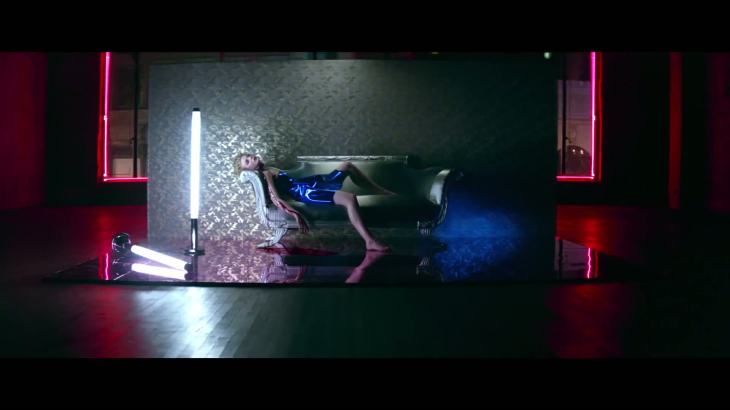
Elle Fanning as Jesse
The film takes us on a journey with Jesse, an orphan who has moved to Los Angeles soon after her 16th birthday to pursue a modelling career. Bright eyed and innocent in every way, she has no time to learn who she can and can’t trust. As the focal point of a powerful story she is brilliant in the way she carries the film on her shoulders.
The supporting cast are excellent. Abbey Lee and Gigi Bella Heathcote put in a great turn as the jealous models Sarah and Gigi. Keanu Reeves’s Hank is reminiscent of his abusive husband Donnie in The Gift, full of brutality and intimidation. It is Jena Malone’s portrayal of doting makeup artist Ruby that really comes close to stealing the show, her face betraying everything she says throughout to brilliant effect.
The Cliff Martinez soundtrack feeds into the visuals perfectly. A frequent NWR collaborator, Martinez’s sparse electronic score blends the contemporary setting with the horrific events that are unfolding on screen. This is a work of art for which he won best soundtrack at the Cannes Film Festival. It’s easy to see why.
This is a sensational film with a powerful leading performance from a girl just seventeen at the time of filming. Pairing this with such bold film making and the result was never going to be anything but an overwhelming success.
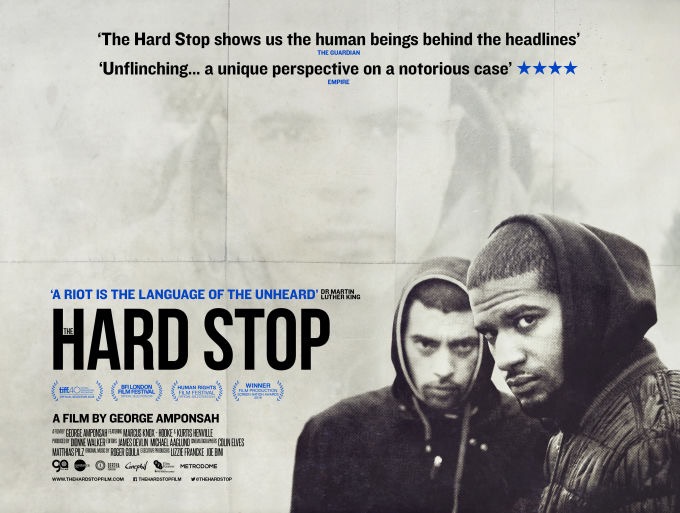
Film review – The Hard Stop (George Amponsah, 2016)
‘The Hard Stop’ documents the 2011 London riots that erupted in the aftermath of the police shooting of Mark Duggan, a 29-year-old black British man. Given the current events in Dallas, Texas, the release of the film couldn’t have been more relevant.
The film concentrates on Marcus Knox-Hooke and Kurtis Henville. Both were close friends of Duggan for many years prior to his death, and both were members of the Tottenham Man Dem, a gang formed out of the Broadwater Farm housing estate in Tottenham. Broadwater Farm was the setting for a brutal riot in 1985 that was believed to be caused by the police raiding a home and causing the heart attack of resident Cynthia Barrett. The main reason it is remembered across the UK is the death of PC Keith Blakelock, the first policeman to die in a riot in the UK since 1833.
The film paints a balanced view of both Marcus and Kurtis. Growing up in the aftermath of the 1985 riots, the two are family-oriented men with their home community at the centre of their make-up. Their upbringing – and that of Mark Duggan – has clearly been one overshadowed by suspicion and resentment for a police force that should be there to protect them, but instead seem to constantly be at odds with their community.

It is an unsettling film for a number of reasons. The media portrayal of the 2011 riots (that quickly spread around the country) seldom touched on the root cause, instead focusing on the looters and chancers that saw it as an opportunity to make some money out of the pandemonium. The anger from the black community in London at the injustice of what happened to Duggan was completely suppressed. I am sorry to say that as a white man, the underlying cause of the riots was not apparent to me and none of the many news outlets I have touch-points with exposed me to the full picture.
The reveal of the eventual findings of the inquest into his death was the most shocking moment of the film. The inquest found that, whilst it was unlikely that Duggan was carrying a gun, the killing was unfathomably still deemed lawful. The emotional response of the community in which Duggan lived was one of absolute devastation and was captured in a moment of brilliant documentary film-making by director Amponsah. This is not a community that wants to fight, but as the opening quote of the film states, “A riot is the language of the unheard.”
‘The Hard Stop’ is one of the most important documentary films to hit the big screens this year. Out of necessity, it is rough around the edges. It has, at the heart of it, some of the greatest social themes facing Britain today. A riveting watch.

Film review – The Lost Bladesman (Felix Chong / Alan Mak, 2011)
The Lost Bladesman is a historical biopic that portrays the story of Guan Yu (Donnie Yen), a general in the Three Kingdoms period of Chinese history. During this period, the land of China was divided into three main states: Wei (魏), Shu (蜀), and Wu (吳).
The kingdoms are at war, and China is in turmoil. Guan Yu has sworn himself to the warlord Liu Bei, but is taken prisoner by opposing warlord Cao Cao (Jiang Wen). Forced to fight for his enemy, Guan Yu leads the Cao army to victory. He is granted freedom but amongst Cao Cao’s supporters he is seen as too great a threat to remain alive. Six of Cao Cao’s most capable supporters embark to kill Guan Yu.
The film is not a traditional telling of the Cao Cao-Liu Bei-Guan Yu story, as director Felix Chong describes in the bonus features: “We wanted to avoid the pre-established image of Guan Yun Chang. We have lots of stories about how he charged into battles, but this time we see him fight his way out of one entrapment after another… The film also concerns itself with his internal struggles and disillusions.” This is certainly something that Donnie Yen pulls off with ease, with the payoff being the drive in the battle sequences – you really believe this is a man unwilling to give up or give in.

Donnie Yen in one of the more memorable action sequences.
It is, admittedly, a story you either need to know the historical relevance of before watching, or something you need to concentrate on in great detail for the first half of the film. As an English-speaker with no knowledge of the Chinese language, trying to keep up with the names of the characters was nigh-on impossible.
Fortunately, pretty soon we are treated to some beautifully-choreographed battles as Guan Yu rips his way through hundreds of men sent to kill him, driven by his loyalty to Liu Bei and his secret passion for the woman betrothed to Liu Bei: Qilan (Sun Li).
The pairing of Donnie Yen and Jiang Wen in this film means it is now of great interest to any fans of Star Wars, with both set to appear in the upcoming Rogue One: A Star Wars Story as characters Chirrut Imwe and Baze Malbus, respectively. Certainly Donnie Yen was brought on board for his martial arts capabilities – not only is he regarded as one of the greatest martial arts actors in film, he is also his own choreographer and is an ex Wushu world champion.
Those martial arts talents are shown in abundance in The Lost Bladesman and anyone looking for a masterclass in the variety of styles of martial arts on show here won’t be disappointed.
For anyone unfamiliar with Chinese cinema, this is a great example of the kinds of high-budget productions typical of the region. The large-scale battle sequences are truly epic and stand up to anything coming out of Hollywood at the present time. Cinematographer Chan Chi-ying clearly works well with the director pairing to deliver shots that are both true to the setting and appealing to the modern audiences.
The climax of the film is, however, a complete anti-climax. Unexpectedly, a paragraph of text appears to wrap up one element of the story, before a brief clip of Cao Cao precedes a second paragraph of text. I couldn’t help but think the money had run out and they were forced into this ludicrous ending, robbing us of a final stand-off or battle of some kind.
Pacing issues aside, the Donnie Yen action sequences make this a film well worth picking up and are a fantastic introduction to his capabilities as a martial arts expert.
 Cinema, etc.