浪華悲歌 / Osaka Elegy (Kenji Mizoguchi, 1936)

浪華悲歌 / Osaka Elegy, now eighty years old, came midway into director Kenji Mizoguchi’s career. Despite this, it is one of the earliest examples of Kenji Mizoguchi’s work readily available to view by the general public and has just been restored and released by Artificial Eye as part of a boxset titles The Mizoguchi Collection.

By today’s standards, it has a strange narrative that seemingly unravels itself from a reasonably happy place to a completely unhappy place for everyone unlucky enough to be wound up in the story. It is built around telephone operator Ayako (Isuzu Yamada), a girl who uses manipulation out of desperation for her own family. Her father is struggling to keep afloat financially after finding himself unemployed and owing 300 JPY. Her brother is also in desperate need of money to pay for his tuition fees or he will be thrown off his course. A solution presents itself in the form of Sumiko Asai (Yoko Umemura), the owner of a successful drugs company who has taken a shine to Ayako. Agreeing to be his mistress to solve the financial issues, she soon realises that the solution isn’t quite as simple as she had hoped.

The topics covered by the film are explored and exploited. It’s a clever technique as the initial story seems quite bland. As the reality is revealed to those involved Ayako comes out as the only person to be perceived to be in the wrong. Several men have had an affair with a girl under half their age, effectively buying her time, but they are above the law due to their standing in society. Since she is perceived to be of a lower class, it is on her that the blame is left.

She was in fact trying to live by her giri morals – the duty to do right by ones family. Whilst her methods may be unorthadox, she never sways far from these morals. The most upsetting part is her final line in the film, revealing that she believes herself to be a delinquent.

The quality of the film is lost slightly by the poor condition of the remaining footage. Throughout the film there are issues with sound – the constant background hiss is quite off-putting, there’s the odd loud pop and the dialogue can feel muffled. It’s not inaudible, but a far cry from perfect.

Similarly, the picture quality is poor, particularly in the darkened interiors of the traditional Osakan houses where the blacks appear muddy. This, like the sound, is not the fault of Artificial Eye. They’ve clearly made a decent job of some imperfect source material. It’s a shame, but realistically this is a business venture and spending the money to restore relatively obscure Mizoguchi films would be hard to justify.

As I understand, the other three films in this box set (The Story of the Last Chrysthanthemum, Utamaro and His Five Women, Sisters of the Gion) are all in the same boat, with imperfections in both audio and visuals (I haven’t watched them yet). That these films have surfaced at all is enough to be grateful for and those looking for more Mizoguchi after enjoying the Master of Cinema releases will be well served. As such, despite the flaws this box set is a recommended purchase.
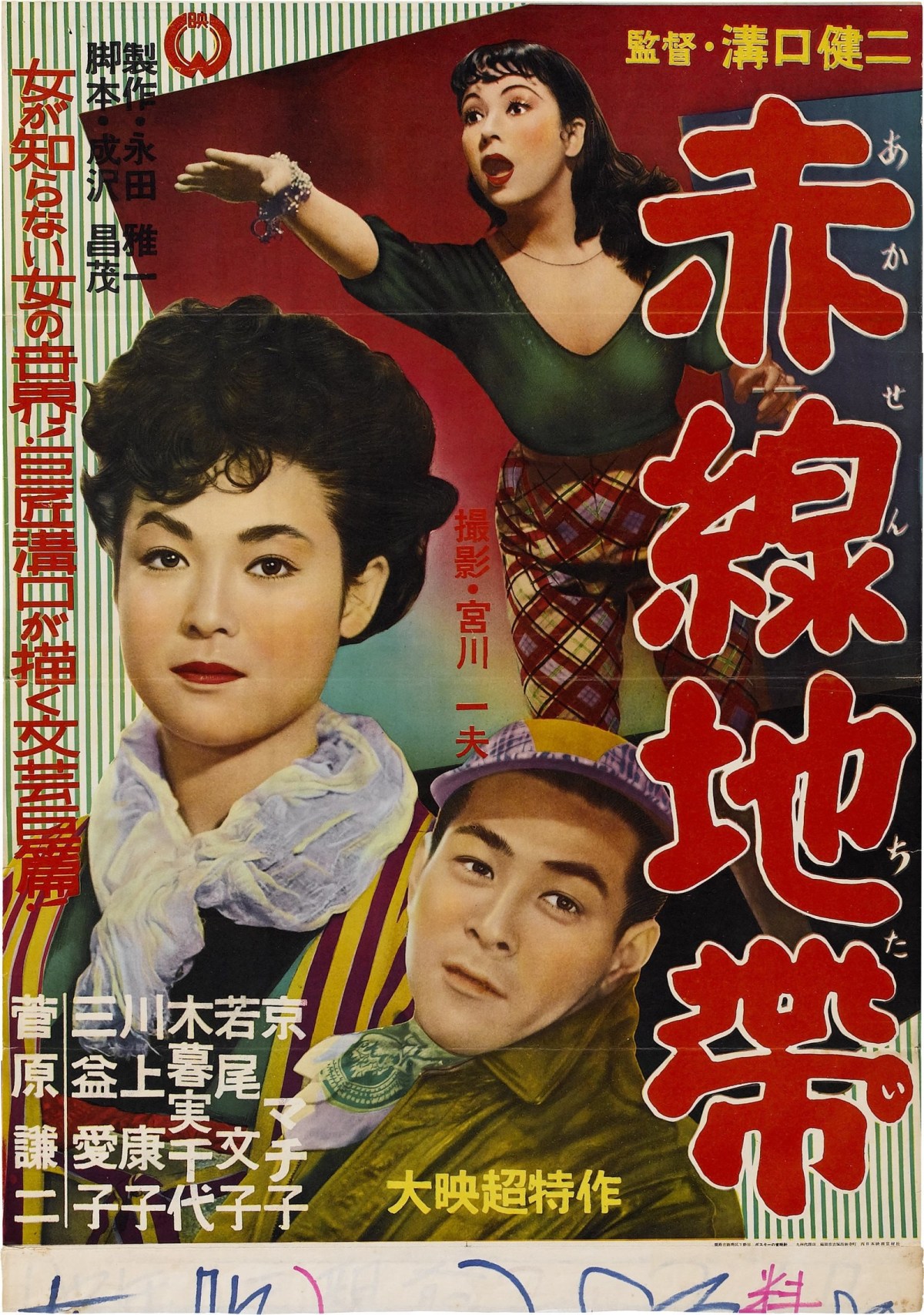


赤線地帯 / Akasen Chitai (Kenji Mizoguchi, 1956)

One of the highlights of the Late Mizoguchi boxset, and indeed Mizoguchi’s entire career, is the film Akasen Chitai. Literally translated as “red-line district”, the film concentrates on the legal brothels of post-war Tokyo. Two months after its release a groundbreaking law was passed in Japan that made prostitution illegal in Japan, putting an end to the “red-line” and “blue-line” zones that had operated up to that point. Mizoguchi would die in August of the same year whilst developing his next film “An Osaka Story” (later directed by Kōzaburō Yoshimura). This Akasen Chitai would prove to be his final film.

The five stars of a five-star film.

The five stars of a five-star film.

The film follows the fortunes of five prostitutes working in Dreamland, a legal brothel, contemplating their future should the Diet pass a law to make their profession illegal. The five lead characters – Yasumi (Akayo Wakao), Hanae (Michiyo Kogure), Yumeko (Aiko Mimasu), Yorie (Hiroko Machida) and Mickey (Machiko Kyô) – all form a central part of the plot in different portions of the film.

Hanae has arguably the most heart-breaking story. Trying to make ends meet to support a young child, her husband suffers from depression and suicidal tendencies as his inferiority engulfs his being. She is not a natural in her profession as her colleagues and if often criticised for her “scruffy” appearance. The only thing she fears more than her job is the possibility that she will lose her job in the near future. It is a complex and depressing sub-plot that

Conversely, the glamorous Yasumi is a compulsive liar who is playing on the emotions of her most devoted client to get him to buy her presents and give her monetary hand outs. It takes a skilled director to convince the audience to find sympathy for such a character, but that he does.

It is Mickey that eventually becomes the focal point of the plot. She arrives as a young and confident new employee at Dreamland and immediately proves popular amongst the clientele. Whilst her colleagues are all working out of desperation and a hope for a better life, it later transpires that Mickey has runaway from the home of her successful business-owning father. The scene in which he arrives to take Mickey home and avoid a family scandal is perhaps the film’s most powerful and memorable, full of elements of the mise en scène Mizoguchi was so famous for.

Whilst the overarching message is that of depression and desolation, the the film is effective because the characters are believable. There are also elements of humour littered throughout. For example, when the aging Yorie discovers one of her frequent clients with the younger Mickey. An argument ensues and the client calls her a whore, to which her response is “If I’m a whore then what does that make you?”, setting up the perfect response: “I’m the client!”

It may not have been his planned swansong, but Akasen Chitai is an excellent way to bookend the career of a masterful director.

Akasen Chitai is available as part of the late Mizoguchi boxset, though you may find the price of the DVD a little more palatable.